
In mathematics, commutative diagrams are used in several fields such as algebraic topology, homological algebra, category theory, etc. In simple words, a commutative diagram is a pictorial way of writing an equation. An equation has two sides, the left and right. Similarly, a commutative diagram has paths. Formally, a commutative diagram is a collection of objects and arrows. The objects could be sets and the arrows could be maps. We say that a diagram commutes if going from one object to another along different paths gives the same result.
In the preceding paragraph, we said, “a collection of …” or we can also say, “a set of …” It is very important to define a set as it is easier to express other concepts in terms of it. Sometimes, it becomes circular when defining some very basic concepts. A set is one of them. If we say that a set is a collection of elements, we see that a set is defined in terms of its synonym. Still, it is possible to define a set as something that contains elements that share a common property. For instance, a set of fruits. We see that in the set of fruits we cannot place vegetables.
It was enough of a backstory. Let us come to the two main concepts that we deal with in this chapter. The first one is called life before death (LBD) and the second one is life after death (lad). Note the acronym. The former is denoted by uppercase letters, whereas the latter is symbolized by lowercase letters. This distinction is used for later convenience. When we say, “life before death,” we mean the entire lifespan of one before death. It should not be confused with near-to-death experiences.
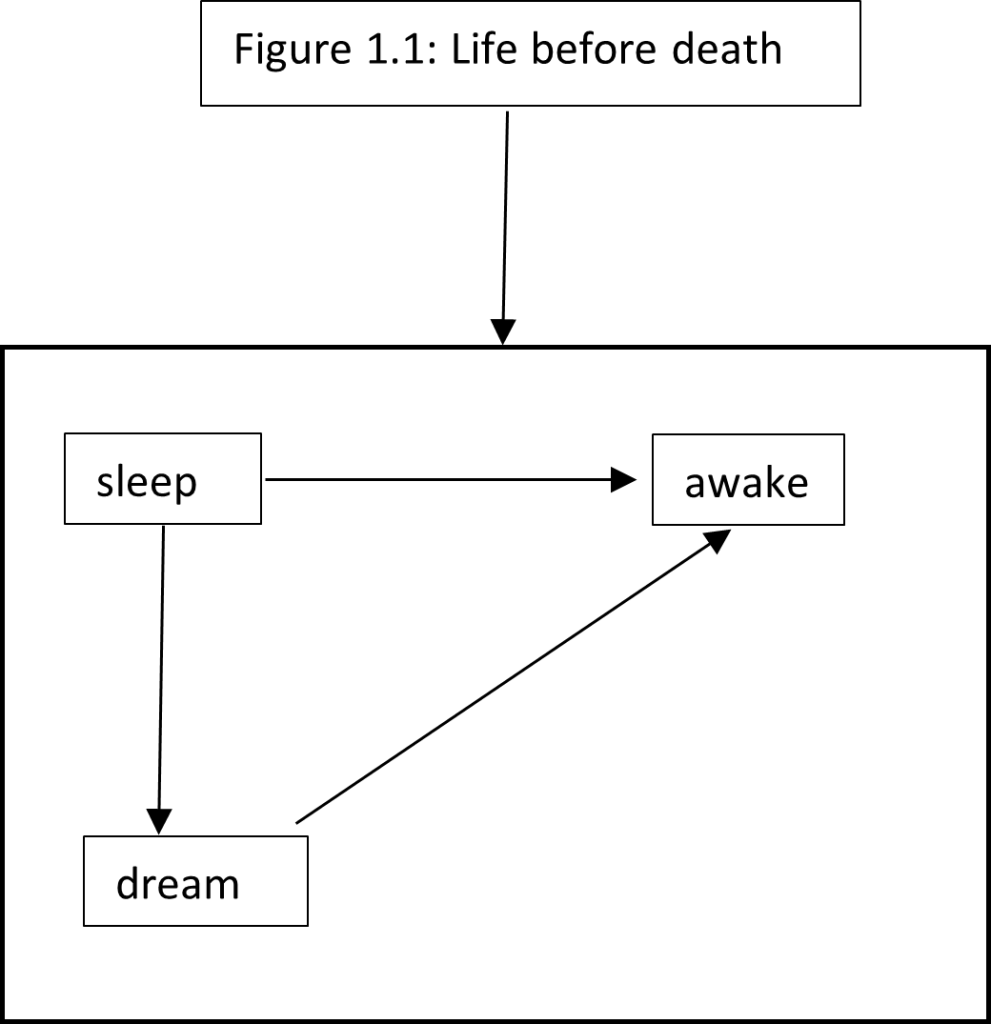
Next, we define LBD. One way to define something is to call it a set of something. For instance, if we ask what the United States is. We can say that it is a set of 50 states. In the same way, we define LBD as a set of three elements: sleep, awake, and dream. This is so because one is either in the state of sleep or awake. While sleeping, one is dreaming. Several questions arise here. Particularly regarding the state of awake. If we include the state of the dream in the set, we should also incorporate what we do while awake. We can say that awake is the state where the laws of physics are in place. In real life, we cannot fly without aid such as gliding, parachuting, or skydiving. In a dream, we can fly without an external agent. But again, some dreams are so vivid they cannot be differentiated from being awake. Let us say that awake is the state in which one goes from one dream to another. The cycle continues till one dies.
We wish to describe LBD by a commutative diagram. For this, we also need to include the arrows (paths) in the definition of LBD. So, the complete definition of LBD is that it is a collection of sleep, awake, and dream along with the paths that connect them. Our next task is to identify these arrows. It turns out that these paths are, in fact, various narrators who tell the story. We know that there are three types of narrators. 1) First-person narrator denoted by POV1. The pronouns used in POV1 are I/me, we/us/our. 2) Second-person narrator is described by POV2. The pronoun used is you, and 3) Third-person narrator is represented by POV3. The pronouns used are he/him, she/her, they/them, and it/its. Here, POV is used as an acronym for point of view.
We also need to identify the protagonist of the story. We find that the main character is the ‘dying person (DP).’ By a dying person, we mean any person who is alive. We know from experience that people eventually die. Therefore, DP is not an individual who is near death. We identify POV1 with DP, POV2 with the loved ones of DP, and POV3 with everyone else. In this chapter, we will only discuss the perspectives of POV1 and POV3. POV2 will be discussed elsewhere in the book.
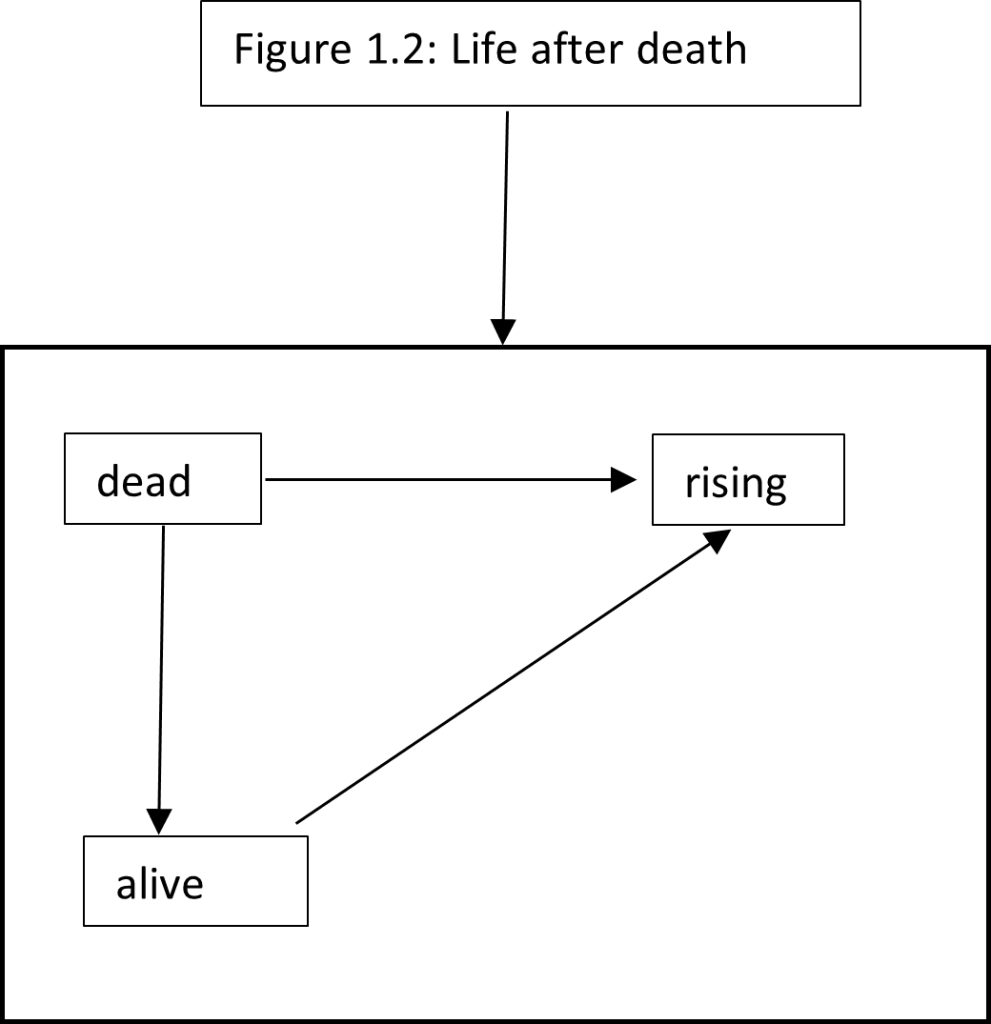
Here, our main concern is to understand Figure 1.1 and Figure 1.2. Let us begin with Figure 1.1. We see that there are four arrows. One is the outer arrow that originates from the caption of the figure and ends on the content of the figure. We will get to this arrow in a moment. First, let us elaborate on the internal arrows. We identify these paths with POVs.
According to POV1, one goes from sleep to awake along the path: sleep à dream à awake. This is so because DP knows that while sleeping, he dreams. His dream ends by waking up. Whereas according to POV3, DP goes along the path: sleep à awake. This is so because POV3 cannot sense the dream of DP. Since both paths begin with the same source and end on the same target, they commute. Thus, the two POVs are equivalent—they see the same thing with different details. Note that sometimes we use a source for the initial object and a target for the final object. Now we come to the outer arrow. As this arrow sends the caption to its body, we call it the name of DP. Let the name of DP be X.
Now we come to the difficult part of the problem and that is how we get to the content of Figure 1.2 when we know nothing about the afterlife. First, a little bit of back story again. In mathematics, we deal with theorems. To remind ourselves, a theorem is a statement that is proven. To prove a theorem, one needs something to begin with. That something is called ‘given.’ Using logical reasoning and other facts, one arrives at the proof of the theorem. Here we are also dealing with a theorem. Let us first state our theorem:
“If there is life before death (LBD), then there is life after death (lad).”
We will call this theorem the fundamental theorem of life and death (FTLD). Since we have stated a theorem, it needs to be proved.
We see that LBD is the given part of the theorem and lad is to be proved. To prove it we need a one-to-one correspondence. So that we can send every object and their associated arrows of LBD to lad. First note that according to one-to-one correspondence, aka bijection, every element of the source set has exactly one and only one partner in the target set such that no element is left without a partner and no element in either set has more than one partner. For bijection, we need three objects and their associated arrows of LBD to map into the corresponding objects and arrows of lad.
From experience, we know that if a person is not alive, he is dead. Thus, we obtain one object of lad and that is the state of dead. Let us map the state of sleep into the state of dead. Before we discover the other objects of lad, we remark that the state of dead is the superior form of the state of sleep. Therefore, the superior form of the state dream is the state alive, and that of awake is rising.
So far, we partially proved the theorem. We also need the corresponding arrows. For that, we remind ourselves of the dying person (DP), and so after death, the dead person would be called dp. Note again the acronym. Any attribute of life after death (lad) will be denoted by lowercase letters. Thus, DP is mapped into dp. If POV1 is DP, then pov1 is dp. Similarly, POV2 is sent into pov2, where pov2 are the loved ones of dp who already died before him. Lastly, POV3 is mapped into pov3, where pov3 is everyone else who passed away before dp. We almost proved the theorem. Just the last outer arrows remain to be mapped into each other. Since the outer arrow of LBD is the name of DP, therefore the outer arrow of lad is the name of dp. We call DP by the name X. Hence, we call dp by the name x. And thus, we send X into x. Hence, we proved the theorem!
 Mr. Monologue